
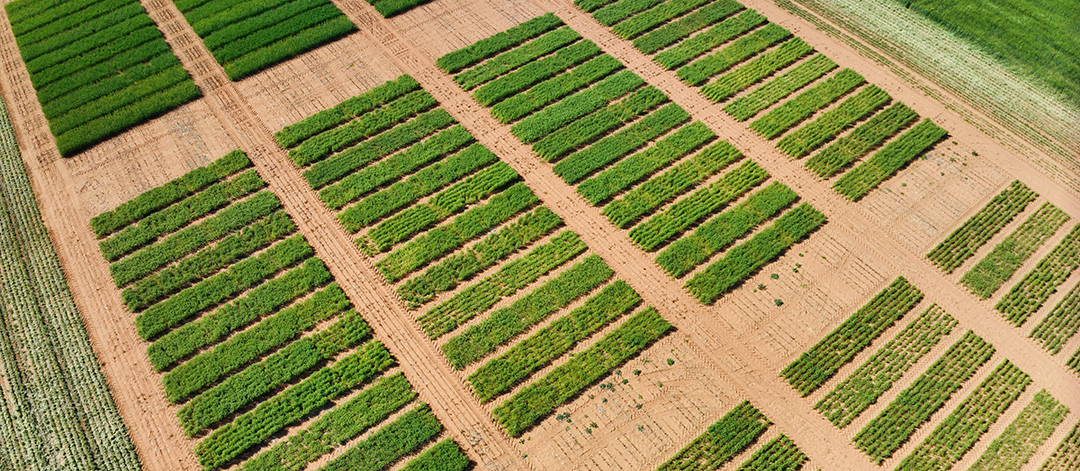
BUILDING DROUGHT RESILIENT PULSES
Lentil Lessons
Interactive tools and short videos exploring lentil crop performance in Mallee farming systems
Drought resilience begins with preparation and the adoption of practices that protect soils while maintaining productivity. Pulses — and lentils in particular — have become a key part of Mallee farming systems, contributing significantly to the financial viability of the region.
These digital resources, developed with the support of the Mallee CMA, focus on lentil production in the Mallee and aim to share practical knowledge on reducing production risks before and during drought conditions.
Through a series of videos, visual guides and simple tools, the resources explore agronomic practices that help growers prepare for challenging seasons and better understand how management decisions influence crop performance. Applying sound practices before, during and after drought helps support the long-term productivity and resilience of farm businesses and the communities that depend on them.
Early Sowing
Sowing in the best adapted variety the optimum sowing window (mid April – early May), maximises biomass development and ground cover. This ensures that in a drought we have the best chance to maximise grain yield, while protecting our soil.
Stubble
Maintaining standing residue, where possible, optimises plant and pod height, maximising harvestability and yield potential.
Delayed Sowing
Slower biomass development, reduced ground cover, lower pod height are all critical issues that can occur with delayed sowing in the Mallee. Combined these reduce yield potential and increase risks of crop failure in drought.
Modern Varieties
Improved pod height and lodging resistance, great adaptability to a range of soils and environments, resistance to disease and tolerance to herbicides are all features of modern lentil varieties. Growing these varieties with the best agronomic practices for your region ensures we have a drought resilient pulse.
Frost and Heat Stress
If drought wasn’t enough – it amazing how often we experience significant frost or heat events during the reproductive phase of lentils. Despite the tough challenges there is often still hope as being semi-indeterminate, lentils can re-flower, re-pod and re-produce grain.
Weed and Disease Management
Weed and Disease Management can be frustrating in a drought. We all want to reduce costs, but still want to avoid weed blowouts or risk of disease if conditions suddenly are conducive. And what if it turns out to not be a drought?
Good weed control maximises water availability, while disease control ensures we have a healthy plant able to utilise that available water.
Estimating Grain Yield and Biomass
Is it worthwhile harvesting my crop? Estimating your grain yield and biomass can help to make an educated decision
— no lab equipment needed.
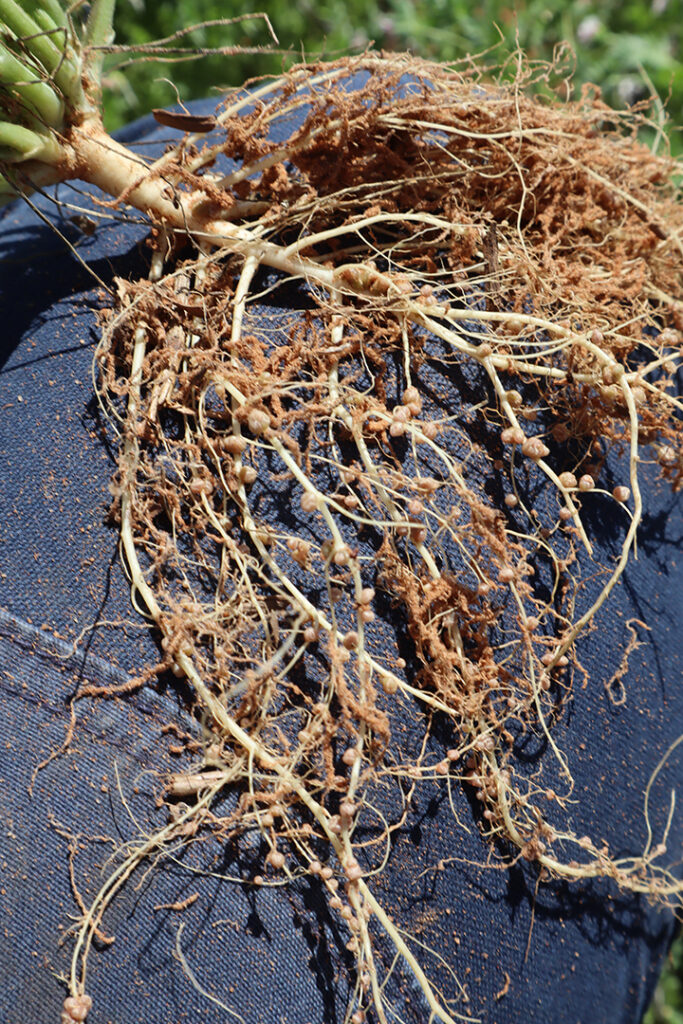
Remember, a well nodulated plant can contribute >20kg/ha nitrogen per tonne of biomass to the following cereal crop
Estimating Your Grain Yield
Count what you can see in the paddock — plants, pods, and seeds — to predict how many tonnes per hectare you’ll harvest.
How the Formula Works
🌱Grain Yield Calculation
Plant density x Pods/plant × Seeds/pod × (Seed wt ÷ 100) ÷ 100 = Grain Yield (t/ha)
🌱Plant Density
Count plants along 1 m of row at 3–5 locations and average. Divide by your row spacing in metres to get plants/m². (e.g. 30 plants ÷ 0.3 m = 100 pl/m²)
🫛Pods Per Plant
Select 10 representative plants and count all pods on each. Record the average number of pods per plant.
🔬Seeds Per Pod
Open at least 20 pods and count the viable seeds inside each. Average the count across your sample.
⚖️Seed Weight
Use the published hundred-seed weight (g/100 seeds) for your variety, or weigh 100 seeds from your own crop.
Sample Data — Lentil GIA Colombo
| Measurement | How You Get It | Value |
|---|---|---|
| Crop / Variety | Species and cultivar | Lentil — GIA Colombo |
| Plant density | Count along 1 m row ÷ row spacing (m), avg 3–5 spots | 100 plants/m² |
| Pods per plant | Count all pods on 10 plants, take average | 20 pods/plant |
| Seeds per pod | Open 20+ pods, count viable seeds, take average | 1.1 seeds/pod |
| Hundred seed weight | Variety data sheet or weigh 100 seeds | 5.1g / 100 seeds |
Step-by-Step Calculation
Plant density x Pods/plant × Seeds/pod × (Seed wt ÷ 100) ÷ 100 = GY (t/ha)
20 × 100 × 1.1 × (5.1 ÷ 100) ÷ 100 = 1.12 t/ha
Estimated Grain Yield
GIA Colombo lentil, this paddock sample = 1.12 t/ha
Biomass Estimation Formula
Biomass (t/ha) = Sample Weight (g) ÷ Area Sampled (m²) × 10
How to Take Your Sample
📍Select the Location
Choose an area with consistent establishment and measure your row spacing before starting.
🌱Timing of Assessment
The best estimate of biomass is during late pod fill as plants and turning yellow and before they have dropped leaves.
✂️Cut & Weigh
Cut all plant material at ground level along a 1m measure across 3 rows. Weigh it fresh in grams.
🔢Calculate the Weight
Multiply: Row Length × Rows × Row Spacing. Convert centimetres to metres for the final area.
Step-by-Step Calculation
① Calculate sampled area: 1.00 m × 3 rows × 0.30 m= 0.90 m²
② Divide sample weight by area: 200 g ÷ 0.90 m²= 222 g/m²
③ Convert g/m² to t/ha: × 10 ÷ 1,000≈ 2.2 t/ha
Handy Lentil Field Guide
| Sample (g) | Yield (t/ha) |
|---|---|
| 90 g | 1.0 |
| 135 g | 1.5 |
| 180 g | 2.0 |
| 225 g | 2.5 |
| 270 g | 3.0 |
Supporting resilient lentil crops
Successful lentil crops are the result of many small decisions made throughout the season. Soil conditions, seasonal rainfall and crop management all influence how crops establish, grow and ultimately perform.
The examples and resources on this page highlight how practices such as early sowing and maintaining stubble cover can support crop establishment and soil protection, while delayed sowing, frost, heat stress, weeds and disease can all affect crop growth and yield potential.
By exploring the videos, visual guides and tools provided, growers and advisers can better understand how lentil crops respond to both favourable and challenging conditions.
Improving our understanding of these relationships helps support better decisions in the paddock, contributing to more resilient pulse crops, stronger farming systems and more sustainable Mallee communities.
Continued learning and sharing of practical knowledge will remain critical to supporting resilient farming systems in the Mallee.
This project of the Regional Drought Resilience Planning program received funding from the Australian Government’s Future Drought Fund and the Victorian Government.
